Season 1 · Episode 4
One Flew Over The Kuru Nest
29:03Updated June 26, 2026
How does Monticello span to Kuru and the cannabilistic Fore people of Papua New Guinea? Traverse from Thomas Jefferson and his plan for maple sugar, ending slavery, and the Louisiana Purchase, westward expansion along the Oregon Trail, the fate of the Donner Party, cannibalism, Fore people, Daniel Carleton Gajdusek, and the Kuru prion disease.
In this episode
Kicked Out of Mount Vernon
This one opens with a confession: one of us nearly got thrown out of George Washington's house. The crime was chewing gum. A guard at Mount Vernon spotted it, delivered the firm reminder that this is a museum, sir, and set off a quiet panic in which a whole tour group of fellow gum-chewers discreetly tucked their wads into their cheeks before anyone else could be singled out. It is a small and very human story, and it is also, improbably, the first step on a path that ends at the strangest infectious agent biology has ever found, one that carries no genes at all. The road there runs through a founding father's sugar idealism, a doomed wagon train, and a funeral ritual on the far side of the world. The thread holding it together, the whole way, is what people choose to eat.
Jefferson's Maple Scheme
From Washington's Mount Vernon it is a short hop to Thomas Jefferson's Monticello, and to one of Jefferson's lesser-known enthusiasms: maple sugar. Jefferson was close with Dr. Benjamin Rush, the Philadelphia physician, signer of the Declaration, and one of the more outspoken abolitionists among the founders. In the late 1780s Rush threw himself into an unusual campaign to get Americans to sweeten their tea with sugar tapped from maple trees instead of cane. The appeal was not only that maple was cheap and homegrown. It was moral. Cane sugar was grown by enslaved people in the West Indies; maple sugar could be made by free farm families in a New England spring. Rush's stated aim was to cut the demand for slave-grown sugar and, by doing so, to help strangle slavery itself. To prove the product, he staged a kind of scientific tea party, pouring cups sweetened with equal measures of cane and maple sugar for guests including Alexander Hamilton, who agreed the maple was every bit as sweet.
Jefferson signed on with gusto. He urged farmers to keep a stand of sugar maples the way they kept an apple orchard, and he put his own land to the test, buying sixty saplings from a Long Island nursery and having them planted in a grove at Monticello. Virginia, it turned out, is too warm for good sugaring, and the trees died, nearly all of them within a few years. The grand scheme to make the young United States a sugar power never materialized. But maple sugar caught on enough in the North to become a real provision, the kind of thing a family would pack for a long trip. And in the 1840s, a great many families were about to take the longest trip of their lives.
The Oregon Trail
They packed it onto the Oregon Trail, the roughly two-thousand-mile overland route from the Missouri River to the valleys of Oregon, beaten in by fur traders and trappers and considered passable for wagons by about 1840. The provisioning lists were enormous: hundreds of pounds of flour and bacon per adult, beans, a keg of rendered fat for a butter substitute, sometimes live cattle driven alongside, and yes, sugar, including maple sugar carried west from the world Jefferson and Rush had been promoting. Canned food existed but was new and expensive, so most families ate what they could carry and what they could forage, picking berries and currants along the way, the stray vitamin C warding off scurvy without anyone quite knowing why.
As the traffic grew, so did a small industry of guidebooks promising the fastest way west. A guidebook is a wonderful thing until it is selling you a shortcut. That is the hinge this whole story turns on, because one such promoter talked one such party into one such shortcut, and the result is the most infamous tragedy of the westward migration.
The Donner Party
In the spring of 1846, a group that would swell to about eighty-seven people, several families plus stragglers met along the way, set out from Springfield, Illinois, bound for California in a column of ox-drawn wagons. Near Fort Bridger they chose to leave the established trail for a new route called the Hastings Cutoff, named for a self-promoting guide named Lansford Hastings who had publicized it as a faster way to California despite never having traveled the full route himself. It was not faster. It dragged them across the Wasatch Range and the punishing salt flats west of the Great Salt Lake and added something like a hundred and twenty-five miles, costing them weeks they did not have. By the time they reached the Sierra Nevada in late autumn, an early and ferocious snowfall had sealed the passes, and the party became trapped near Truckee Lake, now called Donner Lake, for the winter of 1846 to 1847.
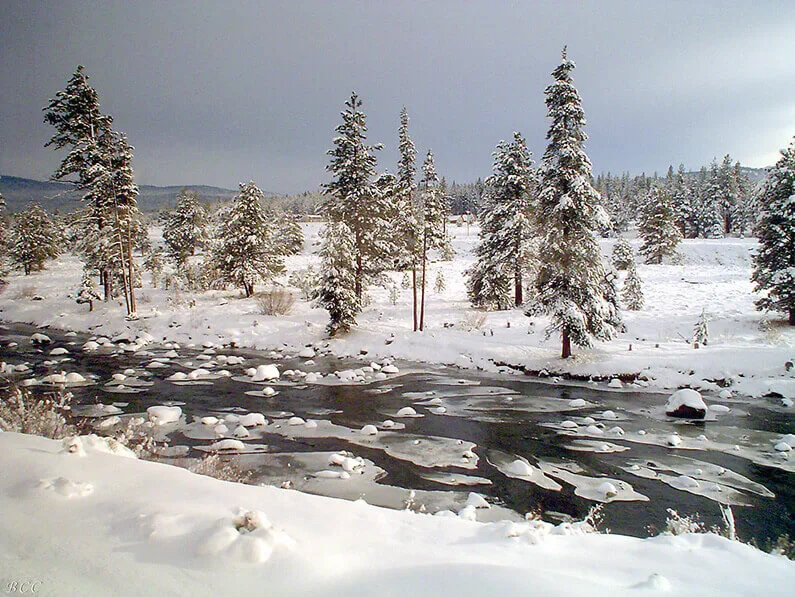
What followed is the part everyone half-remembers. Supplies and livestock gave out. A small group strapped on snowshoes in mid-December and set off to find help; the first relief party did not reach the camps until the middle of February, almost four months after they were trapped. People later photographed the tree stumps the survivors left behind and found them twelve feet tall, not because anyone climbed the trees but because that was the depth of the snow when the trees were cut. Of the roughly eighty-seven who set out, about forty-eight survived, most of them women and children. They survived, in the end, by eating the bodies of those who had already died. The Truckee River and the lake that bears the party's name are the quiet backdrop to that fact.
Kinds of Cannibalism
Cannibalism, it turns out, comes in categories. Exocannibalism is eating someone from outside your own group, the stuff of warfare and, in the modern imagination, of serial killers. Endocannibalism is eating someone from within your community or family, which is closer to what the Donner Party did under the extremity of starvation. And then there is ritual or funerary cannibalism, eating the dead not to survive but as a rite, a way of honoring or mourning them. The Donner Party is survival cannibalism, a horror born of circumstance. But the case that turns this episode from history into microbiology is funerary, and it belongs to the Fore people of the eastern highlands of Papua New Guinea.
The Fore practiced a funerary cannibalism in which deceased relatives were mourned by being consumed, a way of returning the dead person to the community and helping free the spirit rather than leaving the body to rot in the ground. The work of preparing and eating the dead fell largely to the women and the children, who handled the corpses and ate the organs, including the brain. That detail, who ate the brain, is the whole story, though no one knew it yet. Through the middle of the twentieth century, Fore women and children began dying by the thousands of a mysterious affliction no outsider had ever described.
Kuru, the Trembling Death
They called it kuru, from a Fore word meaning to shake or tremble, because that is how it began: a creeping loss of coordination, an unsteady stance, a gait that wobbled and failed. The medical term is cerebellar ataxia, the breakdown of the brain's coordination center, and footage of afflicted Fore shows people unable to stand without support or to bring their own fingertips together. It had a crueler nickname too, the laughing sickness, because in its course patients' faces would contort into something between a smile and a grimace, bursts that looked like laughter wrung out of failing muscles. The disease moved through three stages, from the still-walking phase, to the inability to walk unaided, to a final stage of helplessness, difficulty swallowing, and wasting, with death usually following within roughly six months to two years of the first symptoms. It was, without exception, fatal, and there was no treatment then and none now.
The most unnerving feature was the delay. Kuru's incubation period averaged around a dozen years and could stretch to fifty or more, so a meal eaten in childhood could kill someone in middle age. The epidemic appears to have grown from a single seed: sometime around 1900, one Fore individual likely developed a spontaneous case of Creutzfeldt-Jakob disease, a rare brain disorder that arises on its own in roughly one in a million people. That person died, was eaten according to custom, and the agent began to spread, concentrated in the brain and passed on most efficiently to the women and children who consumed it. The men, who largely abstained from the brain, were mostly spared.
A Protein That Folds You
In 1957, an American researcher named Daniel Carleton Gajdusek, working with the physician Vincent Zigas, brought kuru to the world's attention, and Gajdusek went to live among the Fore to study it. Back in the United States he did the experiment that cracked it open: he inoculated chimpanzees with brain tissue from people who had died of kuru, and after a long wait, one of the chimps, named Daisy, developed the disease. That proved kuru was transmissible, an infection rather than a purely inherited or environmental condition, even though no one could find any virus, any bacterium, any DNA or RNA at all in the infectious material. For that work Gajdusek shared the Nobel Prize in 1976. A veterinarian named William Hadlow had already noticed, in 1959, that kuru looked uncannily like scrapie, a fatal brain-rotting disease of sheep that leaves the animals scraping themselves raw against fences.
The agent with no genes turned out to be a prion, a word coined by the neurologist Stanley Prusiner, who won his own Nobel in 1997 for the idea. A prion is simply a protein gone wrong. The normal protein, called PrP, sits on the surface of nerve cells in a tidy, coiled, alpha-helical shape. The dangerous version is the same protein folded into a flat, sheet-like form (the abbreviation for that misfolded form borrows from scrapie, the first such disease recognized). What makes it infectious is monstrous in its simplicity: the misfolded protein, on contact, coaxes a normal copy to refold into the bad shape, which then converts the next one, and the next. Picture a circle that touches a square and becomes a square. The misfolded proteins pile up into dense clumps called amyloid plaques and punch the brain full of microscopic holes until it looks like a sponge, which is why this whole family of illnesses is called transmissible spongiform encephalopathy.
If that sounds like an exotic problem confined to a remote highland, the modern world got its own lesson in the 1980s. British cattle began staggering and collapsing with a new prion disease, bovine spongiform encephalopathy, better known as mad cow disease. The cause was a kind of industrial cannibalism: cattle were being fed protein supplement rendered from the remains of other animals, including other cattle, recycling the misfolded protein through the herd. It then crossed into people who ate contaminated beef, surfacing in the mid-1990s as variant Creutzfeldt-Jakob disease and killing 178 people in the United Kingdom. One scholar called it the first man-made epidemic, since it took a human decision, feeding ground-up animals to herbivores, to move the pathogen into our food. The Fore had stumbled into the same trap with their funerals, just by hand.
One Flew Over the Kuru Nest
So that is the whole improbable chain, from a gum-chewing scolding in George Washington's house, through a founding father's dream of free-labor sugar, a guidebook's fatal shortcut, and a New Guinea funeral, to a protein that folds you to death. The connective tissue, start to finish, is food and the cultures we build around it, and how readily both carry disease. It is tempting to look at the Fore and see something alien and self-inflicted, a people who ate their way into a plague. But the more honest reading, and the one the show lands on, is that every culture has customs that quietly harm it, the oversized soda and the cigarette as much as the funeral feast, the same stubborn human habit of repeating what we know hurts us.
Kuru leaves two strangely hopeful footnotes. When the Fore gave up cannibalism around 1960, the disease stopped finding new victims, and the last case appeared around 2009, the long fuse finally burning out. And in the survivors, researchers found something remarkable: a protective variant of the prion gene that had spread through the population under the pressure of the epidemic, natural selection caught in the act, in real time, in living memory. The scariest infectious agent we know is not even alive. It does not breathe, eat, or carry a single gene. It is only a shape, copying itself one fold at a time. One flew over the kuru nest, and what it left behind rewrote what the word infection is allowed to mean.
Hosts
Microbiologist, writer and host
Microbiologist and co-host
Sources and Credits
- CreditWritten and performed by Dr. Dustin Edwards and Dr. Faith Cox (opens in a new tab)
- MusicCrinoline Dreams by Kevin MacLeod (opens in a new tab)incompetech.com via filmmusic.ioCC BY 4.0
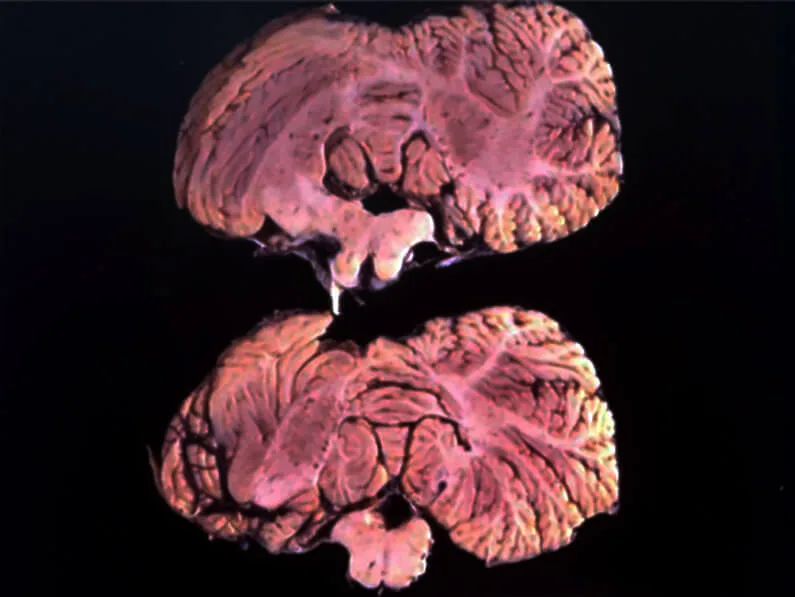
- ImageCerebellum from a Kuru-infected Fore patient (opens in a new tab)Daniel Carleton GajdusekCC BY 3.0
- ImageTruckee River (opens in a new tab)Bruce CooperCC BY-SA 3.0
- referenceSugar Maple (Thomas Jefferson Encyclopedia) (opens in a new tab)Monticello.orgBenjamin Rush's maple-sugar campaign and 'scientific tea party' with Alexander Hamilton; Jefferson bought sixty sugar maples from the William Prince Nursery for Monticello; the aim was to undercut slave-grown West Indian cane sugar.
- referenceThomas Jefferson and the Maple Sugar Scheme (opens in a new tab)Colonial Williamsburg JournalOf the sixty saplings planted at Monticello, all died within a few years; Virginia proved too warm for commercial sugaring.
- referenceDonner Party (opens in a new tab)Wikipedia~87 members took the Hastings Cutoff and were trapped near Truckee Lake (now Donner Lake) in winter 1846-47; the snowshoe 'Forlorn Hope' left Dec 16 1846; first relief arrived mid-February 1847; only 48 survived.
- referenceDonner party (History, Route, Facts, Survivors) (opens in a new tab)Encyclopaedia Britannica87 people (29 men, 15 women, 43 children) in 23 ox-drawn wagons; the Hastings Cutoff, promoted by an unreliable guide, was ~125 miles longer than the established trail.
- referenceKuru (disease) (opens in a new tab)WikipediaPrion disease of the Fore of Papua New Guinea spread by funerary cannibalism; 'kuru' means trembling; also called 'laughing sickness'; women and children most affected; chimp 'Daisy' confirmed transmission; a protective PrP variant was found in 2009.
- referenceKuru (StatPearls) (opens in a new tab)NCBI Bookshelf / NIHPrototype human prion disease, first reported by D. Carleton Gajdusek and Vincent Zigas in 1957; cerebellar signs; death within one to two years of symptom onset.
- referenceKuru - an overview (opens in a new tab)ScienceDirect TopicsTransmitted by ritualized endocannibalism; illness duration 6-36 months, mainly in women and children who consumed the highest-prion tissue; cannibalism stopped in the late 1950s; mean incubation ~12 years (range 5-56).
- referenceKuru: Genes, Cannibals and Neuropathology (opens in a new tab)PMC (J. Clin. Neurosci. review)First human neurodegenerative disease proven transmissible; led to Nobel Prizes for Gajdusek (1976) and Prusiner; kuru imposed balancing selection on the Fore at PRNP codon 129; Hadlow linked kuru to scrapie in 1959.
- referencePrions (Learn.Genetics) (opens in a new tab)University of Utah, Genetic Science Learning CenterPrPC (normal) misfolds to the scrapie form; misfolded prions kill neurons leaving the brain full of holes; the Fore cooked and ate their dead (women and children), explaining the sex/age pattern; cannibalism's end halted spread.
- referenceKuru: The Extinct Prion Disease of Ritual Cannibalism (opens in a new tab)Liberski et al. (review)Two Nobel Prizes: Gajdusek 1976 (transmission to primates) and Prusiner 1997 (nature of the agent); no one born after cannibalism ended (~1960) developed kuru; last case in 2009.
- referenceUnited Kingdom BSE outbreak (opens in a new tab)WikipediaMad cow disease (BSE) and its human form variant CJD struck the UK in the 1980s-90s; over four million cattle were slaughtered; 178 people died of vCJD from eating infected beef.
- referenceAbout Variant Creutzfeldt-Jakob Disease (vCJD) (opens in a new tab)U.S. CDCvCJD is caused by eating meat from BSE-infected cows; feeding cattle meat-and-bone meal from dead cows fueled the UK outbreak; first vCJD cases reported 1996, ~10 years after exposure.
- referenceVariant Creutzfeldt-Jakob disease (opens in a new tab)WikipediaDescribed as the first 'man-made epidemic': feeding meat-and-bone meal to herbivorous cattle moved an animal prion into the human food chain.
Transcript
Listen and subscribe
Related
Antitoxin Togo, Please
What do blue jeans have to do with diphtheria antitoxin and the 1925 Serum Run to Nome? Follow the journey from Levi Strauss and the Gold Rush to the 1925 serum run, where sled dogs raced to deliver life-saving antitoxin. Timeless fashion and infectious diseases might seem like an unlikely pairing, but history has a way of weaving together the unexpected.
Hell on Weils
How does Mardi Gras and Carnival connect to leptospirosis? From New Orleans parades to Brazil’s Carnival, uncover the link between reservoirs, Leptospira bacteria, and the hidden dangers lurking in water and soil.
Rabies Day Out
How does the Google no internet Dinosaur Game connect to Rabies? Haunt over the Raven by Edgar Allen Poe, classic Universal monster movies, psychological thriller and horror by Hitchcock, Kubrick, and Stephen King – including Cujo, and rabies and post exposure vaccine treatment.