Season 1 · Episode 9
Hell on Weils
13:24Updated June 26, 2026
How does Mardi Gras and Carnival connect to leptospirosis? From New Orleans parades to Brazil’s Carnival, uncover the link between reservoirs, Leptospira bacteria, and the hidden dangers lurking in water and soil.
In this episode

From Mardi Gras to the Mud
New Orleans during Mardi Gras is one long party, the streets a blur of parades and floats and beads and king cakes in purple, green, and gold. It is also, less festively, a city whose rats carry a long list of pathogens, including the one behind this episode: leptospirosis. That juxtaposition is the whole story in miniature. The biggest celebrations on Earth tend to happen in exactly the kind of place this disease loves, warm, crowded, and prone to flooding, and the festival in Rio de Janeiro that dwarfs even Mardi Gras, Carnaval, sits in the middle of just such a city. So how does a street party connect to a bacterium most people have never heard of? The answer is a lesson in seeing the unseen. Leptospirosis is the most widespread animal-borne disease in the world, and it is nearly invisible, hiding silently in animals and erupting in people only sometimes. The way you catch something that hides is to watch the creatures it hides in. This is an episode about reading the warning signs, and the warning signs are written not in us but in the animals around us.
The Canary in the Coal Mine
In Brazil in the late 2000s, the forests went quiet. Howler monkeys, normally among the loudest animals in the Americas, began dying in large numbers, and the silence was itself the alarm. Testing the dead monkeys revealed yellow fever virus, and because New World monkeys sicken and die fast when infected, their die-offs work as an early-warning system; Brazil runs a national surveillance program built on exactly this, using monkey deaths to trigger human vaccination ahead of an outbreak. During the 2008-2009 yellow fever outbreak in southern and southeastern Brazil, those monkey deaths preceded the human cases and helped drive a vaccination campaign of millions of doses.
This is the old idea of the canary in the coal mine made literal. For most of the twentieth century, miners carried caged canaries underground, watching for the bird to falter as a sign of toxic gas; Britain only retired the practice in 1986. The principle keeps proving itself. In 1999, residents of New York City noticed an unusual number of dead crows around the same time that an unexplained cluster of human encephalitis appeared, and the two turned out to share a cause: West Nile virus, making its first-ever appearance in the Western Hemisphere. The crows were the sentinels. Epidemiologists have argued, sometimes in pieces with deliberately silly titles, that we still under-use animal populations this way, because so many dangerous pathogens live in an animal reservoir, a host that can carry and shed a microbe without being sick itself, long before they reach people. A reservoir can be an animal, like sheep quietly carrying anthrax, or an environment like soil or water, or even a person, the asymptomatic human carrier of whom Typhoid Mary is the most famous. For leptospirosis, the reservoir and the sentinel are often the same humble creature: the rat.
Hell on Weils
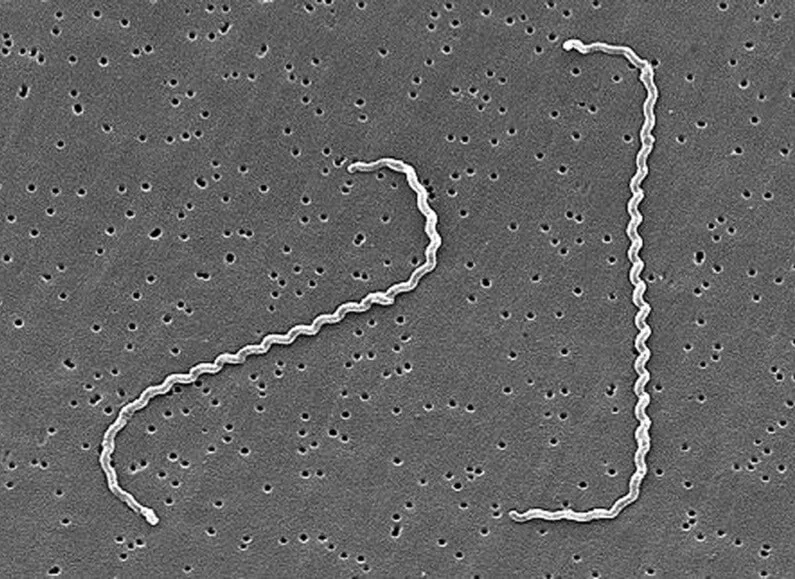
The disease has a second name, Weil's disease, after the nineteenth-century German physician who described its severe form, which is why you sometimes hear it said with a softer, V-like opening. It is caused by Leptospira, a spirochete, a bacterium coiled like a tight little spring with hooked ends, propelled by internal flagella that let it bore through skin and tissue. It is, by most reckonings, the most common zoonotic infection on the planet. The trick to its success is where it lives: Leptospira colonizes the kidneys of animals, brown rats above all but also dogs, cattle, pigs, and wildlife, and those animals shed it in their urine, often for life, without falling ill. From there it pours into soil and standing water, where it can survive for weeks.
People catch it not from a bite but from the water and mud, when the bacteria slip in through a cut, a scrape, or the soft tissue of the eyes, nose, or mouth. That is why the classic victims are people who get wet in the wrong places: kayakers, swimmers, rowers, farmers, veterinarians, sewer workers, and, above all, the residents of crowded tropical cities after a heavy rain, when floodwater stirs the rats' world into everyone's. The World Health Organization estimates more than a million severe cases and on the order of fifty-nine thousand deaths a year, concentrated in exactly those warm, flood-prone, densely populated places. In the United States, by contrast, there are only about a hundred to a hundred and fifty cases a year, roughly half of them in Puerto Rico.
The Disease That Hides
What makes leptospirosis so easy to miss is that most of the time it barely announces itself. Around ninety percent of infections are mild, a flu-like stretch of fever, headache, and aching muscles that people often never report, assuming they simply caught a bug. The illness can run a biphasic course, an early phase when the bacteria are in the blood, a brief lull, and then, in a minority, a second and far nastier phase. Roughly one in ten cases turns severe, with abrupt high fever, vomiting, and the jaundice, a yellowing of the eyes and skin, that signals the kidneys and liver are failing. The worst version is the one Weil put his name to: severe leptospirosis with multi-organ involvement, where kidney failure, liver failure, bleeding into the lungs, and meningitis can converge into a high-mortality crisis.
Doctors confirm it by amplifying the bacterium's DNA with PCR, by testing for antibodies, or by culturing the organism from a sample like urine. Caught in time it is treatable, with oral antibiotics such as doxycycline or amoxicillin for milder cases and intravenous antibiotics for severe ones. There are vaccines for animals and pets, which is part of how you protect people, but no widely approved human vaccine in the United States. A disease this common and this often-silent is precisely the kind you would want an early-warning system for, which brings the whole thread back around.
The Party and the Plague
The festival and the outbreak turn out to share a single stage. Carnaval and leptospirosis both flourish in the warm, crowded, rain-soaked tropical city, and the very rains that can flood a celebration are what flush the spirochete out of the rats and into the people wading through the water. What stands between the party and the plague is mostly a question of attention, of whether anyone is reading the signs, and the signs, as this episode keeps insisting, are not in us until it is late. They are in the animals first: the howler monkeys going silent in the trees, the crows dropping out of a city sky, the rats moving through a flooded gutter with a passenger in their kidneys. Leptospirosis is hell on Weils precisely because it hides, in plain water, in healthy-looking animals, in a fever that feels like nothing much. The way to find a disease that hides is to look where it lives and to watch the creatures that carry it, because they tend to fall quiet before we do.
Hosts
Microbiologist, writer and host
Microbiologist and co-host
Sources and Credits
- CreditWritten and performed by Dr. Dustin Edwards and Dr. Faith Cox (opens in a new tab)
- MusicMain Stem by the U.S. Army Blues (opens in a new tab)Free Music ArchiveCC0 1.0
- MusicModern Jazz Samba by Kevin MacLeod (opens in a new tab)incompetech.comCC BY 4.0
- ImageCarnaval Queen, Rio de Janeiro (opens in a new tab)CC BY-SA 4.0
- ImageLeptospira (opens in a new tab)Janice Haney CarrCDCPublic domain
- referenceLeptospirosis (StatPearls) (opens in a new tab)NCBI Bookshelf / NIHLeptospirosis (Weil disease) is the most common zoonotic infection in the world, caused by the spirochete Leptospira and spread through the urine of infected animals via contaminated soil or water; the severe icteric form (Weil disease) can progress to multi-organ failure.
- referenceA Challenging Case of Weil's Syndrome in New York City (opens in a new tab)PMCLeptospira colonize the renal tubules of reservoir animals (rodents, dogs, sheep, horses), which shed the bacteria in urine for life; ~90% of cases are mild (anicteric), a minority progress through a biphasic course to jaundice, renal failure, meningitis, or pulmonary hemorrhage (Weil's disease).
- referenceLeptospirosis - Weil's disease (global burden) (opens in a new tab)Travel Health Doc, citing WHOWHO estimates over 1 million severe cases and nearly 59,000 deaths annually, primarily in tropical and subtropical regions with poor sanitation and frequent flooding; Leptospira are coiled, motile spirochetes with hooked ends.
- referenceWeil's Disease in an HIV-Infected Patient (US epidemiology) (opens in a new tab)PMCLeptospirosis is uncommon in the US, with about 100-150 cases reported annually, the majority in Puerto Rico and Hawaii; only 5-10% develop the severe liver-and-kidney-failure form (Weil's disease).
- referenceSurveillance for Yellow Fever Virus in Non-Human Primates in Southern Brazil (opens in a new tab)PMC (PLoS Neglected Tropical Diseases)Sudden die-offs of New World monkeys (especially howler monkeys, Alouatta) signal yellow fever virus circulation and provide early warning to humans; Brazil uses monkey-death surveillance to time vaccination, including during the 2008-2009 outbreak.
- referenceCrow Deaths as a Sentinel Surveillance System for West Nile Virus, 1999 (opens in a new tab)CDC, Emerging Infectious DiseasesThe 1999 West Nile virus outbreak, the first in the Western Hemisphere, killed thousands of American crows; dead crows became a recognized early-warning surveillance system for the virus.
- referenceNYC reports first cases of West Nile virus (1999) (opens in a new tab)History.comAs an unexplained encephalitis cluster appeared in New York City in 1999, residents noticed large numbers of dead crows and dead birds at the Bronx Zoo; the shared cause was West Nile virus.
Transcript
Listen and subscribe
Related
Antitoxin Togo, Please
What do blue jeans have to do with diphtheria antitoxin and the 1925 Serum Run to Nome? Follow the journey from Levi Strauss and the Gold Rush to the 1925 serum run, where sled dogs raced to deliver life-saving antitoxin. Timeless fashion and infectious diseases might seem like an unlikely pairing, but history has a way of weaving together the unexpected.
Rabies Day Out
How does the Google no internet Dinosaur Game connect to Rabies? Haunt over the Raven by Edgar Allen Poe, classic Universal monster movies, psychological thriller and horror by Hitchcock, Kubrick, and Stephen King – including Cujo, and rabies and post exposure vaccine treatment.
A Boy Named Flu
What do kindergarten arts and crafts have to do with influenza and the flu? Take a trip down memory lane with grade school activities, remembering Columbus sailed the ocean blue in 1492, the transfer of infectious disease with European colonization of the Americas, the dangers of influenza then and now, and the flu vaccine.