Season 1 · Episode 5
It’s On The Syphilis
23:27Updated June 26, 2026
How do Hollywood summer blockbuster movies connect to sexually-transmitted syphilis? Take a journey from Jurassic Park and Contagion to Oscar Awards, Ignaz Semmelweis and handwashing, Treponema pallidum and syphilis, the No Nose Club, and the infamous Tuskegee Experiment.
In this episode

Could, and Should
When Jurassic Park opened in 1993 it was less a movie than a weather system. It won three Academy Awards, it was sold as an adventure sixty-five million years in the making, and for a while you could not get a haircut without the person holding the scissors talking to you about DNA. It put genetic engineering into ordinary conversation, and it handed the culture two lines it never gave back. One was Jeff Goldblum's geneticist insisting that life finds a way. The other was his warning that the park's scientists had been so consumed by whether they could bring dinosaurs back that nobody stopped to ask whether they should. That gap, between can and ought, is the real subject of this episode. The trail from a dinosaur blockbuster to a corkscrew-shaped bacterium runs through a diseased Ice Age bear, a doctor destroyed for being right, and the darkest chapter in the history of American public health, and the whole way down it is asking the same uncomfortable question.
The Bear Ain't Talking
Start with the bear. In 1987, the paleopathologist Bruce Rothschild reported in Nature that the bones of a Pleistocene bear from Indiana, roughly eleven and a half thousand years old, carried lesions characteristic of treponemal disease and tested positive with the same antisera the CDC used to confirm syphilis. It was the oldest case of the disease family ever detected with modern methods. Asked how he could be sure whether the animal had syphilis or its close cousin yaws, Rothschild gave the only honest answer: you would need a medical history, and the bear is not talking. He leaned toward yaws, since you otherwise have to explain how a bear contracted a venereal disease.
The joke sits on top of a genuinely unsettled question. Treponema pallidum, the bacterium behind syphilis, comes in subspecies that cause yaws and other diseases too, and where venereal syphilis itself came from is still argued. The most widely held idea, the Columbian theory, holds that Columbus's crews carried it back from the New World in the 1490s, just before it exploded across a war-torn Europe. The disease even got its name from a poem: in 1530 the Italian physician Girolamo Fracastoro wrote of a shepherd named Syphilus, cursed by Apollo with the affliction. We can read disease in eleven-thousand-year-old bone and still not agree on where it started, which is a good reminder that detecting a disease and knowing what to do about it are entirely different problems. Nobody learned that more bitterly than the man who discovered handwashing.
The Savior of Mothers
In the 1840s, a Hungarian physician named Ignaz Semmelweis was working at the Vienna General Hospital, which ran two maternity clinics. One was staffed by doctors and medical students, the other by midwives, and the doctors' clinic killed far more mothers, sometimes several times as many, with childbed fever, the bacterial infection that followed birth. Semmelweis was haunted by the discrepancy. He noticed that women who gave birth in the street on the way in fared better than those delivered by physicians, and that the midwives' clinic was safer too. He stripped away every difference he could think of until one remained: the doctors and students went straight from performing autopsies to delivering babies. He concluded they were carrying something he called cadaverous particles from the dead to the living, and in 1847 he ordered them to scrub their hands in a chlorinated lime solution. The maternal death rate in his clinic collapsed, from around eighteen percent to under two.
He was right, and it ruined him. This was before germ theory, so he could not say what the particles were, only that washing removed them, and the medical establishment already had a long list of fashionable explanations for childbed fever into which his idea did not fit. Worse, many physicians took the implication that their own unwashed hands were killing patients as a personal insult to gentlemen. Semmelweis did not help his case; as the years passed he grew bitter and combative, publishing open letters that called the doctors who ignored him murderers. His behavior deteriorated, his wife came to believe he was losing his mind, and in 1865 he was committed to an asylum. He tried to leave, was beaten by the guards, and died about two weeks later at forty-seven of sepsis from an infected wound, the very kind of infection he had spent his life trying to prevent. There is grim irony layered on irony here, because one of the conditions later proposed to explain his unraveling was syphilis.
The Great Imitator
Syphilis was, for most of history, almost everywhere. By some nineteenth-century reckonings a startling share of the population carried it at some point in their lives, and the roster of famous people rumored to have had it is long, mostly unprovable, and a parlor game unto itself. The ragtime that scores this episode is part of that story: Scott Joplin, who wrote The Entertainer and Maple Leaf Rag, declined and died of complications generally attributed to the disease, and composers from Schubert to Beethoven turn up on the same speculative lists, with the emphasis on speculative. What is not in doubt is how common and how protean the disease was, which earned it the nickname the great imitator, because its symptoms mimic so many other illnesses.
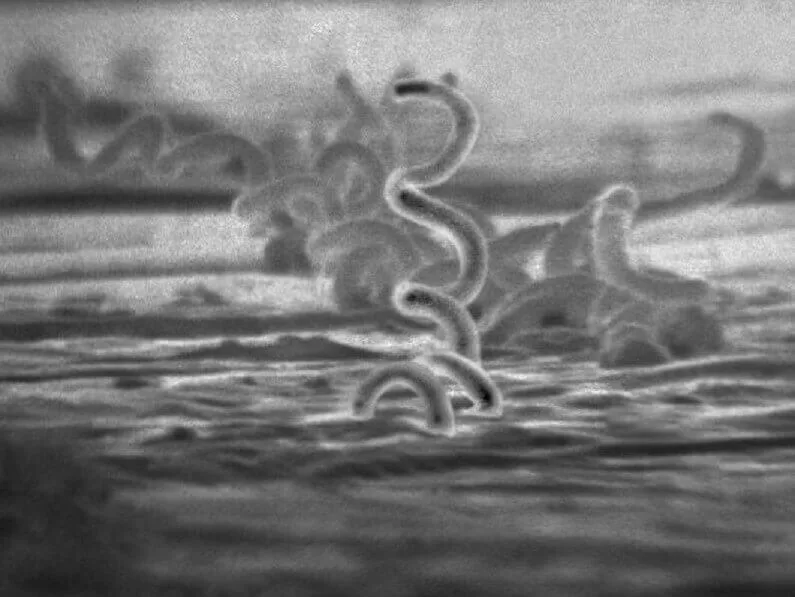
The culprit is Treponema pallidum, a spirochete, a bacterium shaped like a corkscrew, and it moves like one too, its internal flagella spinning it forward so it can bore through the smallest micro-tears in skin. It usually spreads through sex, and a mother can pass it to her child in the womb, which is called congenital syphilis. Untreated, it unfolds in four acts. First, about three weeks after infection, a chancre appears at the entry point, a firm, round, painless ulcer roughly the size of a fingernail. Then, weeks to months later, comes a rash that famously turns up on the palms and soles, along with fever and aches. Then a silent latent phase that can last years. And finally, in perhaps a third of untreated people and sometimes decades later, tertiary syphilis, which is no longer contagious but quietly wrecks the organs it has settled into: the brain in neurosyphilis, the heart and blood vessels, the bones. It could be disfiguring enough to collapse the bridge of the nose, which is the grim origin of the so-called no-nose clubs of old London, where the afflicted gathered to dine in company that would not stare. And then, since the 1940s, the twist that makes the rest of this story unbearable: a few injections of penicillin cure it. We could fix it.
What We Did Instead
For forty years, the United States government chose not to. From 1932 to 1972, the U.S. Public Health Service ran what it called the Tuskegee Study of Untreated Syphilis in the Negro Male, in Macon County, Alabama. It enrolled about six hundred poor Black sharecroppers, three hundred ninety-nine of them already infected with latent syphilis and two hundred one as uninfected controls. The men were never told they had syphilis. They were told they were being treated for bad blood, a vague local term, and were given free meals, free exams, and burial insurance in exchange for letting doctors track them. The purpose was simply to watch untreated syphilis run its course to autopsy. When penicillin became the standard cure in the 1940s, the men were not given it. The study ran on for decades more, and it ended in 1972 only because a whistleblower took the story to the press. By then, of the original infected men, twenty-eight had died of syphilis outright, about a hundred more of related complications, forty of their wives had been infected, and nineteen of their children had been born with congenital syphilis.
It was not an isolated lapse. The same agency, with at least one of the same physicians involved, had in the 1940s deliberately infected prisoners, soldiers, and psychiatric patients in Guatemala with syphilis, sometimes by injection and sometimes by sending in infected sex workers, to study the disease and its treatment. These were not failures of scientific capability. The science was sound enough to identify the spirochete, chart its stages, and cure it. The failure was the one Goldblum's character named in a fictional lab a half century later, made real and monstrous: people so fixed on what they could learn that they never stopped to ask whether they should.
The Cost of Could
So that is the road from a dinosaur movie to a spirochete, and it turns out the dinosaurs were never the point. The point was the warning bolted onto the side of the spectacle. We learned to read treponemal disease in the bones of an Ice Age bear, to name and describe the corkscrew bacterium, to end its four-act tragedy with a cheap injection. None of that was the hard part. The hard part was the question the science could not answer for us, the one about what we owe the people the science is done to. Tuskegee is the answer to why trust in medicine has to be earned rather than assumed, and why it is thinnest in exactly the communities that were once treated as material rather than patients; the distrust it seeded outlived the study by decades and shapes public health to this day. The most important line in a movie about cloning dinosaurs was never about dinosaurs at all. It was the question we keep forgetting to ask before we find out whether we can. It's on the syphilis, and it was on us.
Hosts
Microbiologist, writer and host
Microbiologist and co-host
Sources and Credits
- CreditWritten and performed by Dr. Dustin Edwards and Dr. Faith Cox (opens in a new tab)
- MusicLobby Time by Kevin MacLeod (opens in a new tab)incompetech.com via filmmusic.ioCC BY 4.0
- MusicThe Entertainer by Scott Joplin (opens in a new tab)Free Music ArchivePublic domain
- MusicMaple Leaf Rag by Scott Joplin (opens in a new tab)Free Music ArchivePublic domain
- MusicSymphony No. 5 by Ludwig van Beethoven, performed by the Fulda Symphonic Orchestra (opens in a new tab)EFF Open Audio License v1
- ImageTreponema pallidum (opens in a new tab)David CoxPublic domain
- ImageDilophosaurus (opens in a new tab)Eduard SolaCC BY-SA 3.0
- referenceJurassic Park (1993 film) (opens in a new tab)WikipediaSpielberg's 1993 blockbuster; tagline 'An adventure 65 million years in the making'; won three Academy Awards for visual effects and sound.
- referenceTreponemal infection in a Pleistocene bear (opens in a new tab)Rothschild BM, Turnbull WNature 329:61-62Lesions of treponemal disease in an ~11,500-year-old bear from Indiana, positive with CDC syphilis antisera; earliest detection of treponemal disease by modern methods.
- referenceBear provides earliest evidence of syphilis (opens in a new tab)UPI ArchivesRothschild's quips that the bear isn't talking and that one would otherwise have to explain how a bear got syphilis; he favored yaws.
- referenceIgnaz Semmelweis (opens in a new tab)WikipediaIn 1847 proposed handwashing with chlorinated lime at Vienna General Hospital's First Obstetrical Clinic; maternal mortality fell from ~18% to under 2%; ideas rejected in his lifetime; died 1865 at 47.
- referenceIgnaz Philip Semmelweis: The Tragic Pioneer of Hand Hygiene (opens in a new tab)PMCHypothesized 'cadaverous particles' carried from autopsies to mothers; died shortly after a hand injury/infection, ironically from the kind of infection he sought to prevent.
- referenceSyphilis (opens in a new tab)WikipediaCaused by Treponema pallidum (a spirochete); primary chancre, secondary rash on palms and soles, latent phase, tertiary gummas/neurological/cardiac disease; 'the great imitator.'
- referenceSyphilis (StatPearls) (opens in a new tab)NCBI Bookshelf / NIHColumbian theory of origin (1490s); the name from Fracastoro's 1530 poem about the shepherd Syphilus; four stages; painless chancre and palms/soles rash; humans the only host.
- referenceTreponema pallidum (clinical overview) (opens in a new tab)Rupa HealthStages, congenital syphilis, neurosyphilis, cardiovascular syphilis and gummas; penicillin treatment; 'the great imitator.'
- referenceThe Untreated Syphilis Study at Tuskegee (About/Timeline) (opens in a new tab)U.S. CDCUSPHS study 1932-1972, Macon County, AL; 600 Black men (399 with latent syphilis, 201 controls) told they had 'bad blood'; no informed consent; penicillin withheld even after it became standard.
- referenceTuskegee Syphilis Study (opens in a new tab)WikipediaBy 1972, of the original 399 infected men, 28 had died of syphilis, 100 of related complications, 40 wives were infected, and 19 children born with congenital syphilis; exposed by whistleblower Peter Buxtun.
- referenceFiftieth Anniversary of Uncovering the Tuskegee Syphilis Study (opens in a new tab)PMCThe same group of researchers deliberately infected hundreds of Guatemalans with syphilis and gonorrhea in the 1940s; records surfaced in 2010.
Transcript
Listen and subscribe
Related
Antitoxin Togo, Please
What do blue jeans have to do with diphtheria antitoxin and the 1925 Serum Run to Nome? Follow the journey from Levi Strauss and the Gold Rush to the 1925 serum run, where sled dogs raced to deliver life-saving antitoxin. Timeless fashion and infectious diseases might seem like an unlikely pairing, but history has a way of weaving together the unexpected.
Hell on Weils
How does Mardi Gras and Carnival connect to leptospirosis? From New Orleans parades to Brazil’s Carnival, uncover the link between reservoirs, Leptospira bacteria, and the hidden dangers lurking in water and soil.
Rabies Day Out
How does the Google no internet Dinosaur Game connect to Rabies? Haunt over the Raven by Edgar Allen Poe, classic Universal monster movies, psychological thriller and horror by Hitchcock, Kubrick, and Stephen King – including Cujo, and rabies and post exposure vaccine treatment.