How does coffee connect to the 2003 FIFA Women’s World Cup? Tag along as we talk about Mediteranean conquests, coffee houses, dancing goats, civets, bats, and the deadly Severe acute respiratory syndrome (SARS) coronavirus outbreak in China.
One of us refuses to drink iced coffee. Not "tried it and disliked it," but flatly will not, on principle, having never once let a cold cup near his mouth. The other finds this indefensible. You can write off a food you have never tasted in some cases, the argument goes, but coffee is not one of those things; you have to actually try it before you get an opinion. We have never settled it, which is fine, because the fight was never really about coffee. It was about where a cup of coffee can take you. Follow this one far enough and it runs from a goat in the Ethiopian highlands to the most expensive coffee on earth, to a small caged animal in an Asian market, and from there into the first new plague of the twenty-first century. Here is how a luxury beverage and a deadly virus end up sharing the same animal.
A Berry from Ethiopia
No one knows exactly where coffee began, but the plant is native to the highland forests of Ethiopia, and the legend everyone tells starts there. A goatherd named Kaldi, the story goes, noticed his goats growing strangely lively after eating the bright cherries of a certain shrub, tried the berries himself, and felt the same lift. The tale is almost certainly embroidered, but the Ethiopian origin is not: every arabica plant on the planet traces back to those forests. What is solid history is what happened next. By the fifteenth century coffee was being cultivated and traded across the Red Sea in Yemen, brewed in Sufi monasteries to keep worshippers awake through long nights of prayer, and within a hundred years it had spread through Egypt, Persia, Syria, and the Ottoman world, served in public houses called qahveh khaneh.
Europe got its first real taste through trade with the Ottomans, and the first European coffeehouses opened in Venice around 1645. The drink moved north, and the colonial powers, wanting supplies of their own, went looking for live plants. The Dutch got there first, smuggling specimens out of the Yemeni port of Mocha and nursing them in Amsterdam greenhouses before shipping them to Ceylon and then to Java, the island that lent coffee one of its nicknames. From there cuttings traveled to the Caribbean, to Vietnam, and across the Americas, until coffee grew on nearly every tropical shore. The coffeehouse became its own institution along the way, a place to argue, trade gossip, and read the news. One London coffeehouse run by a man named Edward Lloyd became such a dependable spot for shipping talk that it grew, in time, into the insurance market still known as Lloyd's of London. Coffee, in other words, was always less a drink than a network.
The Most Expensive Coffee in the World
Goats are not the only animals that go for coffee cherries, and one of them produces the strangest luxury in the trade. The Asian palm civet, Paradoxurus hermaphroditus, is a small nocturnal mammal of tropical Asia, about the size of a house cat with a face somewhere between a cat and a young bear. Left to itself, it climbs through coffee plantations at night and eats only the ripest cherries, because it can smell which ones are best. The beans pass through its gut, where digestive enzymes and bacteria break down some of the proteins that make coffee bitter, and come out the other end largely intact, bundled in droppings that, we are sorry to report, look a great deal like a candy bar studded with beans. Collected, cleaned, and roasted, those beans become kopi luwak, from the Indonesian words for coffee and for the civet, and a single cup of it can sell for more than a hundred dollars.
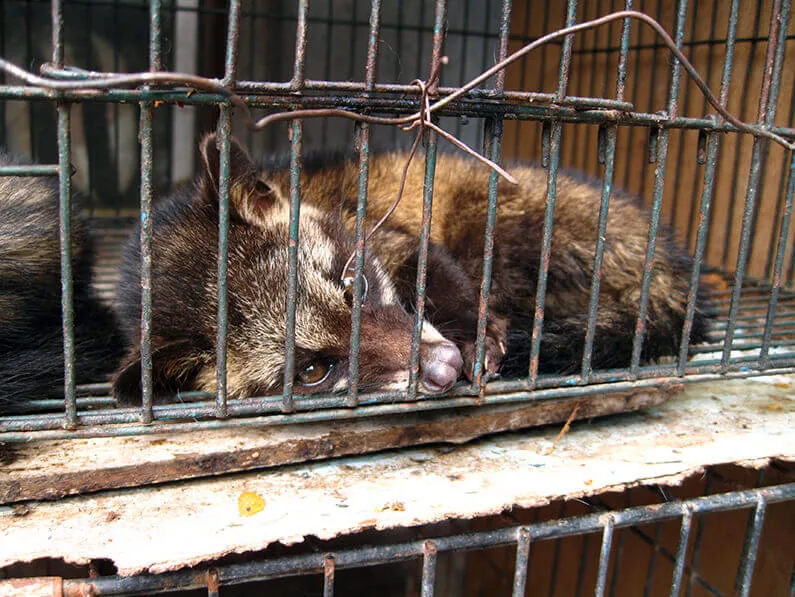
For a while this was good news for the civet, which went from being treated as a pest to being worth protecting. Then the money got ahead of the animal. Producers began trapping civets, packing them into cages, and force-feeding them whatever cherries came to hand, which ruined the very thing that made the coffee special, the animal's wild instinct for the perfect berry. The caged trade was cruel and it was sloppy, and it sent civets, by the thousands, into the live-animal markets of Indonesia, China, and the surrounding region, where they sat stacked among other wild species in close, stressful, unsanitary quarters. Hold that picture of the caged civet in the crowded market. It is where the second half of this story begins.
From a Market in Guangdong
In November 2002, in Guangdong province in southern China, a patient turned up at a hospital in Foshan with a severe atypical pneumonia, the kind not caused by the usual bacterial suspects, and died quickly. Within a few months there were hundreds of cases and dozens of deaths across the province's hospitals, many of them among the nurses and doctors doing the treating; one early spreader, a fishmonger admitted to a Guangzhou hospital, infected dozens of staff by himself. Chinese authorities were slow to share what was happening, delaying reports to the World Health Organization and withholding details from the rest of the country, a silence that almost certainly cost lives and let the outbreak build.
It went global through a single hotel floor. In February 2003 a Guangdong doctor named Liu Jianlun, who had been treating these patients and was feeling unwell, traveled to Hong Kong for a family wedding and checked into room 911 of the Metropole Hotel. In one night he infected other guests on the ninth floor, and they carried the disease out into the world before he was hospitalized and died. By some estimates roughly half of all the cases in the entire outbreak trace back to that one floor. An elderly woman flew home to Toronto and seeded a Canadian cluster that would put thousands into quarantine; a young Singaporean named Esther Mok, also a Metropole guest, survived but started the outbreak there; and a Chinese American businessman named Johnny Chen fell ill after flying to Hanoi and was admitted to the French Hospital, where the staff began dropping one after another.
The doctor who examined Chen was Carlo Urbani, an Italian infectious disease specialist working for the WHO. He recognized within days that this was something new and dangerously contagious, alerted the WHO, and pressed the Vietnamese authorities to isolate patients and screen travelers, buying the world precious time. Then he boarded a flight to a conference in Bangkok, felt the fever rise somewhere over the journey, and was taken straight from the runway to a hospital. He died on March 29, 2003. The disease he had named for the world was Severe Acute Respiratory Syndrome, SARS. Before it was contained that summer, it reached more than 8,000 people across nearly thirty countries and killed 774, a fatality rate of roughly one in ten.
The Animal in the Cage
When investigators went looking for where the virus had come from, they went back to the markets. In the spring of 2003, samples taken from masked palm civets sold as food in Guangdong turned up coronaviruses almost identical to the one making people sick. The masked palm civet is not the same animal as the coffee-making Asian palm civet, but it is a close cousin in the same family, roughly the way humans are related to the other great apes. Authorities responded by culling civets in Guangdong by the tens of thousands and restricting their trade, and for a time the civet looked like the source.
The fuller picture turned out to sit one step further back. The civet strains did not carry enough genetic variety to be the original reservoir; they looked like a virus that had only recently arrived from somewhere else. That somewhere was bats. Cave-dwelling horseshoe bats were found to harbor a rich diversity of closely related SARS-like coronaviruses, and the consensus that emerged is that the virus lived quietly in bats, spilled into civets, and there, in the amplifying crush of the market, picked up the changes that let it infect and pass between people. The animal that bridged bat and human was a civet, the same sort of creature prized, a few hundred miles away, for making the world's most expensive cup of coffee.
A Crown, a Key, and a Lock
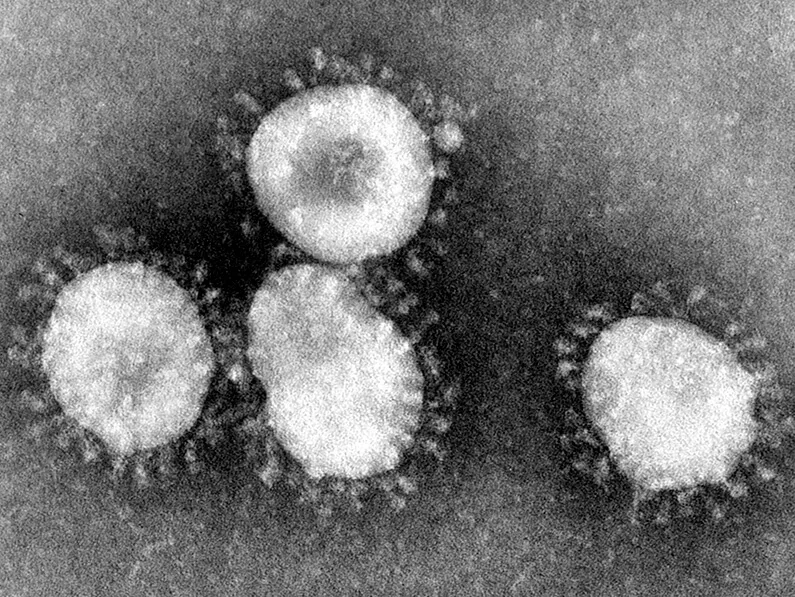
SARS is caused by a coronavirus, and the name is really a description. Studded across the surface of each viral particle, each virion, are spike proteins that stand out like the points of a crown or the rays of a halo. Those spikes are not decoration; they are the key. To get into a human cell the spike has to fit a specific lock on the cell's surface, a receptor called ACE2, short for angiotensin-converting enzyme 2, which the body normally uses to help regulate blood pressure. The fit between that viral key and that human lock is the whole game: change the spike too much and it no longer turns the lock, which is exactly the barrier the bat and civet versions had to clear before they could open human cells.
The rest of the virus is built for travel. It is an enveloped virus, wrapped in a fatty membrane much like the one around our own cells, a trait shared by many of the viruses that spread well in coughs and sneezes. Its genome is a single strand of RNA only about thirty thousand letters long, a rounding error next to the three billion in ours, and it mutates at a moderate clip, enough now and then to change the shape of a protein or what that protein can grab. Coronaviruses are not exotic; milder ones cause a good share of ordinary colds. There was never a cure for SARS, only supportive care to keep patients breathing while their bodies fought it off, which is why the outbreak was beaten not in a laboratory but in the field, through quarantine, isolation, and the unglamorous machinery of public health.
A Sky Full of SARS
What made SARS new was not really the virus. It was the speed. Coffee took centuries to cross from Ethiopia to the Americas, carried by ship a few months at a time. SARS crossed the same oceans in a day, because a sick traveler who could not tell a new plague from a bad cold could carry it from a hotel in Hong Kong to Hanoi, Toronto, and Singapore before the fever even set in. A disease that once would have burned itself out in one isolated place now boarded a plane. A sky full of SARS.
So the thread holds, all the way back to a petty argument about iced coffee. A luxury brewed from the droppings of one civet and a virus carried to us by another are not two stories but one, joined at a cage in a crowded market. The next time someone offers you the most expensive coffee in the world, you will at least know the whole strange family it comes from. We still cannot agree on iced coffee. But that, it turns out, was never really the point.
reference2002-2004 SARS outbreak (opens in a new tab)WikipediaFirst case Foshan, Guangdong, Nov 16 2002; Liu Jianlun, Metropole Hotel room 911; Carlo Urbani; over 8,000 cases, 774 deaths; Amoy Gardens; China's delayed reporting.
referenceSARS (opens in a new tab)WikipediaSARS-like coronaviruses isolated from masked palm civets in Guangdong markets, 2003; >10,000 civets culled; later traced to cave-dwelling horseshoe bats in Yunnan with civets as intermediate host.
What do blue jeans have to do with diphtheria antitoxin and the 1925 Serum Run to Nome? Follow the journey from Levi Strauss and the Gold Rush to the 1925 serum run, where sled dogs raced to deliver life-saving antitoxin. Timeless fashion and infectious diseases might seem like an unlikely pairing, but history has a way of weaving together the unexpected.
How does Mardi Gras and Carnival connect to leptospirosis? From New Orleans parades to Brazil’s Carnival, uncover the link between reservoirs, Leptospira bacteria, and the hidden dangers lurking in water and soil.
How does the Google no internet Dinosaur Game connect to Rabies? Haunt over the Raven by Edgar Allen Poe, classic Universal monster movies, psychological thriller and horror by Hitchcock, Kubrick, and Stephen King – including Cujo, and rabies and post exposure vaccine treatment.